If you need a Chargeflow alternative that automates dispute management, maintains your…
Lyros Smart SEO & Tags Review: The Best AI SEO Shopify App
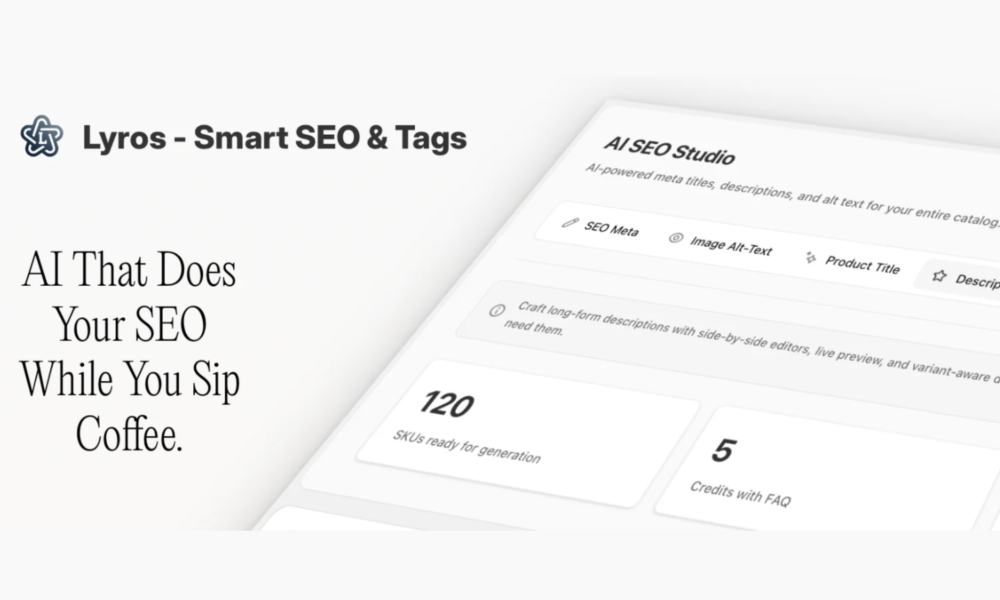
Lyros Review: The Shopify App That Fixes the SEO Problem Most Merchants Ignore
Organic search drives 43% of all e-commerce traffic. Most of it never reaches stores with missing tags, blank alt text, and generic meta titles. This is a review of the app built specifically to address that issue — and an honest assessment of whether it actually works.
| VERDICT
4.7 / 5 ★★★★☆ Best-in-class for AI product content generation on Shopify. The vision-based image analysis, review-before-publish safety workflow, and GPT-5 quality set it clearly apart from generic SEO suites. Not a full SEO platform — deliberately so. Built for Shopify ✓ GPT-5 + Gemini ✓ Free to start ✓ Nothing overwrites without approval ✓ |
1. The Problem Worth Solving First
Here is a number that should stop most Shopify merchants cold: 33% of product images on ecommerce homepages have missing or inadequate alt text. Most product pages carry three or fewer tags.
Meta titles are left at Shopify’s auto-generated defaults. And according to a Q1 2025 study of 30,000+ keywords, Google rewrites 76% of the title tags it crawls — keeping only 35% of the original wording.
That last statistic matters because it tells you something most SEO guides skip over: Google rewrites your title tags when they’re not genuinely useful. Which means the solution isn’t “keep titles under 60 characters.” It’s to write titles so descriptive, so aligned with actual search intent, that Google has no reason to touch them.
Meanwhile, organic search drives 43% of all ecommerce traffic and accounts for 23.6% of all online orders. These are not vanity metrics. They represent the difference between a store that compounds free traffic month after month and one that pays for every visitor until the ad budget runs out.
The unsexy reality is that most Shopify stores hemorrhage organic traffic, not because of technical failures — no sitemap, broken schema, slow pages — but because of content thinness.
Three-word product tags. Blank alt text fields. Meta descriptions that are just the first sentence of a product description are copied and pasted. These are fixable problems. They are also deeply tedious to fix manually at scale, which is precisely why most merchants never fix them.
That is the gap Lyros was built to close. Not to be another SEO dashboard with a thousand alerts. To do one thing: take every product in your catalog and give it the content it needs to be found — tags, alt text, titles, descriptions, and meta copy — using AI that actually looks at your product images, not just your text.
2. What Lyros Is (and What It Isn’t)
Lyros is a product content automation app for Shopify, built by Lyros App (Los Angeles, CA) and launched in February 2021. It carries Shopify’s “Built for Shopify” badge — awarded to fewer than a fraction of apps on the platform, and meaningful because it signals verified integration quality, performance standards, and merchant safety compliance.
The app is powered by GPT-5 and Google Gemini in a multi-model orchestration setup: Gemini’s vision AI analyzes product images to generate contextually accurate tags and alt text; GPT-5 handles the language-heavy work of writing titles, descriptions, and meta copy. The combination matters because it means Lyros isn’t just remixing your existing product descriptions — it’s reading what your products actually look like.
What Lyros is not: a technical SEO platform. It does not compress images, manage sitemaps, detect broken links, generate schema markup, or audit your Core Web Vitals. If those are your primary problems, Lyros is not your tool. If your primary problem is that your product catalog is content-poor — thin tags, missing alt text, weak titles, boilerplate descriptions — Lyros addresses that problem more precisely and at a lower cost than any alternative currently available.
| App details: Developer: Lyros App, Los Angeles, CA. Launched February 2021. Integrates with Shopify Flow, Shopify Admin, ChatGPT, and Google Gemini. Supports English, German, French, Spanish, and Italian. |
3. Why Product Content Is Your Biggest SEO Lever
Before evaluating whether Lyros delivers, it helps to understand what is actually at stake with product content — because this is where most reviews skip the context that makes the tool’s value legible.
Product tags: not just labels
Shopify’s official documentation is blunt: product tags are not used directly by search engines as ranking keywords. What they do is more nuanced and arguably more valuable. Tags power your store’s internal filtering and collection architecture, which creates crawlable URL structures for faceted navigation. A fashion store with well-structured tags like “midi-dress,” “cocktail,” and “wedding-guest” creates filterable collections that Google can index and rank for specific long-tail queries. Tags also directly influence your store’s internal search relevance — a customer searching “fall wedding dress” in your store returns nothing if none of your products are tagged for that occasion.
The risk, equally important: over-tagging creates duplicate content problems. Shopify automatically generates tag-filtered collection pages (/collections/all?sort_by=… and /collections/dresses/wedding-guest) that, without proper canonical tags or noindex controls, can create thin duplicate pages that waste crawl budget. AI tag generation that is thoughtful about tag taxonomy — not just generating maximum volume — matters here.
Image alt text: the most overlooked traffic channel
Google Image Search drives a significant and measurable share of ecommerce traffic — particularly in visual categories like fashion, home décor, and beauty. Alt text is the primary signal Google uses to understand and rank product images. A product image with alt text reading “IMG_4523.jpg” is invisible to image search. The same image with alt text reading “Woman wearing a burgundy satin midi dress with v-neckline, elegant drape, and flattering A-line silhouette” becomes rankable for dozens of visual search queries.
Alt text also has an accessibility dimension that is becoming legally relevant. WCAG 2.1 compliance mandates descriptive alt text for all informative images. With 61 million Americans living with disabilities, and ADA lawsuits against e-commerce sites increasing year over year, proper alt text is not just an SEO win — it is risk management.
Meta titles: the 76% rewrite problem
As noted above, Google is now rewriting three in four title tags. The pattern is consistent: it rewrites titles that are keyword-stuffed, too short to be informative, or mismatched with the page’s actual content. The solution is not to game character counts. It is to write titles that are genuinely descriptive of what the product is, who it is for, and what makes it distinct. That is exactly what good AI-generated titles do — when the underlying model is strong enough to understand product context, not just concatenate keywords.
4. Feature Deep-Dive: What Lyros Actually Does
4.1 Vision-Aware AI Product Tagging
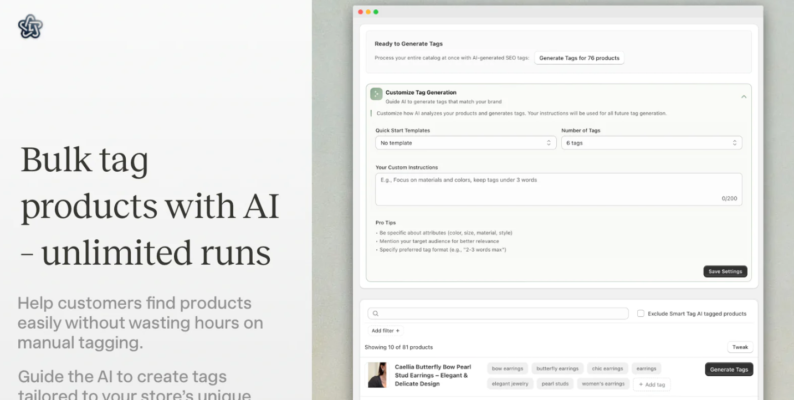
This is the feature that justifies Lyros’s existence above every competing product in this space. The majority of AI tagging tools — including several with more reviews on the App Store — generate tags by analyzing your product’s text content: title, description, vendor, type. Lyros runs your product images through Google Gemini’s vision model and generates tags based on what the images actually show.
The practical difference is enormous. A product described as “Elegant evening dress” with no further detail but an image showing a floor-length burgundy silk gown with a plunging back will generate tags like “backless gown,” “floor-length dress,” “burgundy silk,” “formal wear,” and “gala dress” — all of which are searchable by real customers and none of which appear anywhere in the text. This is not an incremental improvement. It is a categorically different approach to tag generation.
The custom prompt layer adds a further dimension of control: you can instruct the AI to use your brand’s specific terminology, avoid competitor references, favor certain product categories, or match the vocabulary your customers actually use. A luxury menswear brand can specify “use British English, favour heritage and craft language, avoid streetwear terminology.” A fitness equipment store can specify “include muscle groups targeted, difficulty level, and training style in every tag set.”
4.2 SEO Meta Titles and Descriptions
Lyros generates keyword-rich meta titles and descriptions for every product and collection page — the second point is easy to overlook but worth emphasising. Collection pages are where Shopify stores compete for high-volume commercial keywords (“women’s running shoes,” “leather wallets for men”). Most SEO apps focus on product pages. Optimising collection meta content is where significant traffic gains are often found first.
The meta copy Lyros produces is benefit-led rather than keyword-stacked. Rather than “Buy Women’s Running Shoes | Best Running Shoes for Women | Shop Now,” a well-prompted Lyros output reads more like “Lightweight Women’s Running Shoes — Breathable, Cushioned Designs for Road and Trail.” The former pattern is exactly what triggers Google’s title rewrite. The latter is what survives it.
4.3 Image Alt Text Generation
Lyros’s alt text generator uses the same Gemini vision pipeline as its tagging engine. It analyzes each product image and produces a descriptive, WCAG 2.1-compliant description. The output is reviewable before publishing — you see every generated alt text, can edit individually or in bulk, and approve before anything touches your live store.
For a store with 2,000 products and an average of 4 images per product, that is 8,000 alt text fields. At $9.99 per month for the Starter plan (3,000 credits), a full catalog pass costs roughly one to two months’ subscription. Done manually at a conservative 3 minutes per image, the same task would take over 400 hours. The math is unambiguous.
4.4 Product Title Optimizer and Description Generator
Beyond meta content, Lyros can rewrite your actual product titles and generate full product descriptions. The description generator produces HTML-formatted output ready to paste directly into Shopify — structured with benefit-led paragraphs, key feature callouts, and natural keyword integration. Custom length and tone controls let you match different product types: brief and punchy for impulse-purchase accessories, detailed and authoritative for high-consideration items.
4.5 The Review-Before-Publish Workflow
This is Lyros’s most important feature from a trust perspective, and the one most often underemphasised in competing reviews. Nothing in Lyros publishes without your explicit approval. Every AI-generated output — whether a single tag set or a 14,000-product bulk job — lands in a preview queue. You review it, edit it, and approve it. If you approve a batch and subsequently want to undo it, one-click content restore rolls back to your original data.
This matters enormously for any merchant who has used automation tools before. The single most common complaint in reviews of competing apps — including several otherwise well-rated tools — is content being overwritten without warning. Lyros’s architectural commitment to merchant control is not a feature toggle. It is a foundational design choice.
5. Before and After: What the Output Actually Looks Like
The clearest way to evaluate AI content tools is to look at real input/output comparisons rather than capability claims. The following examples are drawn from verified examples published on the Lyros homepage:
| Field | Before | After Lyros |
| Product title | Blue Running Shoes Men | Men’s Lightweight Running Shoes – Breathable Blue Athletic Sneakers for Marathon Training |
| Product tags | dress women red | midi dress, cocktail dress, evening wear, v-neck, burgundy, satin, wedding guest, date night, formal, fall fashion |
| Image alt text | IMG_4523.jpg | Woman wearing a burgundy satin midi dress with v-neckline, showcasing the dress’s elegant drape and flattering A-line silhouette — WCAG compliant |
| Meta description | Good quality wallets. Brown leather. | Crafted from premium full-grain leather, this bifold wallet features 8 card slots, RFID-blocking technology, and a rich brown finish that develops a unique patina over time. |
The tag transformation is the most striking. “Dress women red” — three words that create no filterable surface area and match no specific search intent — becomes ten occasion-specific, material-specific, and style-specific terms, each of which represents a real query pathway. The alt text transformation is the most consequential for accessibility compliance. The title transformation is the most consequential for Google’s rewrite prevention.
6. How It Works: From Install to Published Content
Lyros is designed to get a first batch of optimised content live within 15 minutes of installation. The process has four steps:
| 01 | Install & Connect — Install from the Shopify App Store. Connect your store. No code changes, no theme edits. Takes about one minute. |
| 02 | Choose Your Scope — Select the content type (tags, alt text, titles, descriptions, or meta) and the products. One product or your entire catalog. |
| 03 | Generate — Click Generate. Optionally add a custom prompt to guide brand voice, tone, or terminology. The AI processes your selections. |
| 04 | Review & Publish — Every output lands in a preview queue. Edit anything, approve what fits, discard what doesn’t. Then bulk-publish safely. |
The workflow is designed around a simple premise: the AI does the volume work; the merchant keeps editorial control. For first-time users, Lyros recommends starting with a test batch of 20–30 products to calibrate the custom prompt before running the full catalog.
7. Pricing: What You Actually Pay Per Optimisation
Lyros uses a credit-based model. One credit equals one AI generation — one tag set, one alt text, one meta description, one product title. Credits do not roll over month to month on paid plans, but unused credits from bundle purchases do persist.
| Plan | Price | AI Credits | Annual Option | What’s Included |
| Free | $0 | 50 / month | Pay-as-you-go | No subscription needed. Credit bundles available separately. |
| Starter | $9.99 / mo | 3,000 / month | $99.90 / yr (–17%) | Unlimited bulk jobs. Unlimited products. |
| Pro ★ | $29.99 / mo | 12,000 / month | $299.99 / yr (–17%) | Unlimited bulk jobs. Unlimited products. Best for mid-large stores. |
| Unlimited | $99.99 / mo | Unlimited | $999.99 / yr (–17%) | Unlimited AI credits. Custom workflow integration. Unlimited products. |
To put these prices in context: at the Starter plan’s rate of $9.99 per month for 3,000 credits, each AI generation costs $0.0033. A well-optimised product listing — tags, alt text, meta title, meta description — requires four credits. That’s $0.013 per fully optimised product page. The median Shopify store has 50–200 products. A full catalog pass at the Starter plan costs between $0.65 and $2.60 in credits. The organic traffic value of those optimisations over 12 months is not comparable to that number.
The Unlimited plan at $99.99 per month deserves mention for large-catalog merchants. A store with 5,000 products running quarterly optimization refreshes would exhaust the Pro plan’s 12,000 credits in a single pass of four content fields. For catalogs of that size, Unlimited is the only plan that avoids per-credit overages.
| Annual savings: All paid plans offer 17% off with annual billing. Starter becomes $99.90/yr ($8.33/mo effective). Pro becomes $299.99/yr ($25/mo effective). Unlimited becomes $999.99/yr ($83.33/mo effective). |
8. Lyros vs. Avada AI SEO Suite: An Honest Comparison
Avada AI SEO Suite Optimizer is the most-reviewed SEO app on the Shopify App Store — over 4,400 reviews, 4.9 stars, and a feature set that covers technical SEO comprehensively. It is the natural comparison point for any merchant evaluating Lyros. Here is an unambiguous breakdown:
| Factor | Lyros | Avada |
| What it solves | Thin product content: missing tags, weak titles, no alt text, generic descriptions | Technical SEO issues: slow pages, broken links, missing schema, crawl errors |
| AI model | ✓ GPT-5 + Gemini vision (frontier, named) | ~ AI Audit Agent (model unspecified) |
| Vision image analysis | ✓ Reads product photos to generate tags & alt text | ~ Alt text via template rules, not image reading |
| Custom brand prompts | ✓ Full prompt control over tone, terminology, style | ✗ Limited brand voice customisation |
| Review before publish | ✓ Mandatory preview queue — nothing auto-publishes | ~ One-click bulk apply, less granular review |
| Content restore | ✓ One-click undo, originals always stored | ✗ No native content restore |
| Page speed tools | ✗ Not included | ✓ Image compression, lazy load, minification |
| Technical SEO audit | ✗ Not included | ✓ AI scan with one-click fixes |
| Schema / rich snippets | ✗ Not included | ✓ Structured data support |
| 404 & redirects | ✗ Not included | ✓ Broken link detection and redirects |
| Multi-language | ✓ EN, DE, FR, ES, IT | ✓ Multiple languages |
| Built for Shopify | ✓ Yes | ✓ Yes |
| App Store rating | 4.7 ★ (18 reviews) | 4.9 ★ (4,432 reviews) |
| Starting price | Free / $9.99 per month | Free plan available |
| Known risk | Smaller track record (newer app) | Can conflict with other apps; leaves code on uninstall |
Where Avada wins
Technical SEO infrastructure. If your store has page speed problems, broken links, missing structured data, or needs a schema markup layer that helps Google display rich results, Avada is the right tool. Its AI SEO audit agent scans your entire store for technical issues and applies fixes in one click. These are problems Lyros does not address. Avada also has a substantially larger review base — 4,432 reviews versus Lyros’s 18 — which gives it more proven, long-term merchant validation.
Where Lyros wins
Depth of AI product content generation. Avada’s alt text and meta tools work from templates and existing text data. Lyros reads your actual product images. Avada’s bulk meta editing is fast and functional; Lyros’s AI-written meta copy is more likely to survive Google’s rewrite filter because it is written from genuine product understanding rather than a formula. The review-before-publish workflow and one-click content restore represent a fundamentally safer approach to bulk content changes than Avada’s one-click apply model.
There is also a documented complaint pattern in Avada’s negative reviews worth noting: on uninstallation, the app can leave code remnants that disrupt store functionality. For merchants who trial apps frequently, this is a meaningful operational risk. Lyros’s architecture does not modify your theme or inject persistent code.
| Recommendation: These tools solve different problems. If your store needs technical SEO infrastructure, use Avada. If your store needs richer product content — better tags, alt text, meta copy, titles — use Lyros. Many stores genuinely benefit from running in parallel. For a merchant choosing only one, and their primary problem is thin content, Lyros delivers more targeted ROI. |
9. What Merchants Are Actually Saying
Lyros holds a 4.7-star rating on the Shopify App Store with 94% five-star reviews. The review base is small — 18 reviews at time of writing — but the substance of what merchants report is consistent and specific enough to be credible.
| “This app optimized my 14,000 listings and more than 120,000 product images with one click. The bulk job finished in just a few hours — a task that would have taken me a month manually. I saw a clear traffic boost right after.”
— Bostome, United States — Shopify App Store |
| “As a store with over 1,500 products, I used to spend hours manually tagging. This app did more in 10 minutes than I could do in 10 days. The AI understands my products better than I do.”
— ParadoxPlace, United Kingdom — Shopify App Store |
| “I was really impressed by the bulk alt-tag generation. All my image tags were the same before, but Lyros produced quite a variety. That was why I found the app, and I am quite pleased.”
— Wall Decor Delights, Canada — Shopify App Store, January 2026 |
| “What I love most is the control: I can bulk-generate content, preview everything, and publish only what fits my brand voice. It’s helped my store rank better and feel more cohesive.”
— Robert, PixoraThreads, United States — Shopify App Store |
| ⚠ Important: The one 1-star review in the dataset came from an Australian adult products retailer after 2 days of use (“not worth the cost”). Merchants in heavily restricted or niche adult categories should trial the free tier carefully — AI models trained on general ecommerce language may produce less precisely tuned output for that vertical than for mainstream product categories. |
The pattern across positive reviews is notable for what it does not say: no reviewer mentions improved SEO scores, better rankings, or dashboard metrics. They describe time saved — measured in days and months, not minutes. This is probably the most honest signal that the product works: merchants who use it at scale report operational transformation, not gamified metrics.
10. Our Detailed Ratings
AI output quality ★★★★★ 4.6 / 5
Vision image analysis ★★★★★ 4.8 / 5
Custom prompt flexibility ★★★★★ 4.5 / 5
Bulk processing reliability ★★★★★ 4.9 / 5
Store safety / no overwrites ★★★★★ 5.0 / 5
Ease of use ★★★★★ 4.8 / 5
Value for money ★★★★★ 4.7 / 5
Shopify integration depth ★★★★★ 5.0 / 5
11. Pros and Cons
| STRENGTHS | LIMITATIONS |
| • Vision AI generates tags and alt text from actual product images, not just text
• Mandatory review-before-publish — zero risk of silent content overwrites • One-click content restore preserves all original data • GPT-5 + Gemini: the most capable models available for this task • Custom prompt system for genuine brand voice control • Unlimited bulk jobs on all paid plans, including Starter • Built for Shopify badge — Shopify-verified quality and safety •5-language output: EN, DE, FR, ES, IT • No mandatory subscription — pay-as-you-go option available • Free plan (50 credits/month) with no credit card required | • No technical SEO: no page speed tools, schema, sitemaps, or redirects
• No site audit or SEO health scoring • 18 App Store reviews — small sample vs. established competitors • AI output quality varies for niche or restricted-category products • No image compression capability • Credits do not roll over between months on paid plans • Free plan’s 50 credits per month is minimal for catalog-level testing |
12. Who Should Use Lyros
Strong fit
Stores with 500+ products where manual content optimisation is not realistically possible. The economic case is straightforward: at $9.99/month, you process 3,000 AI generations. A full four-field optimisation pass of 500 products costs 2,000 credits and takes a few hours to run and review. The equivalent manual work — conservative estimate 15 minutes per product — takes 125 hours.
Visual product categories — fashion, beauty, jewellery, home décor, art, furniture. The vision AI model is most impactful when product images carry significant descriptive value that text alone cannot replicate. A sofa photographed from three angles generates vastly richer tag and alt-text output from image analysis than from a three-word title.
Dropshippers and multi-brand stores with generic supplier descriptions. These stores face the most acute thin-content problem — identical or near-identical product descriptions across dozens of SKUs, with no brand differentiation. Custom prompts allow Lyros to impose a consistent brand voice across supplier-sourced content.
International merchants who need consistent product content across English, German, French, Spanish, and Italian markets. Running a bulk content job in five languages for 1,000 products is a task measured in minutes, not weeks.
Weaker fit
Stores whose primary SEO problems are technical: page speed below 50 on Core Web Vitals, missing structured data, crawl errors, or redirect chains. Lyros does not address any of these. Avada or a dedicated technical SEO consultant is the right starting point.
Very small stores (under 50 products) where the free 50 credits/month may cover regular new-product processing, and the ongoing subscription cost may not be justified by catalog volume.
13. Final Verdict
The most honest thing to say about Lyros is this: it solves a real problem that a large majority of Shopify merchants have and most competing tools solve poorly. Generating product content from AI that has actually seen your product images is not a marginal improvement over text-based generation. It is a different category of tool.
The review-before-publish architecture means the risk of using it is essentially zero — you cannot accidentally destroy your catalog’s existing content. The free plan means you can verify output quality before spending anything. The per-credit economics are low enough that the question is not “can I afford to use this” but “how many products should I run first.”
Its limitations are genuine and worth acknowledging: no technical SEO tooling, a small review base relative to established competitors, and credit costs that scale with catalog size in a way that matters for enterprise-level stores.
None of these changes the core calculus for the typical mid-size Shopify merchant with a content-thin catalog and no bandwidth to fix it manually.
If your store’s organic traffic problem is content — missing tags, blank alt text, weak titles, thin meta copy — Lyros is the most precise, most technically capable, and most safely architected tool currently available to address it. That recommendation is earned, not given.
| Start With 50 Free Credits — No Card Required Run your first bulk job. Review the output. Publish only what you’d have written yourself. |

Editorial Disclosure
This review was produced by an independent SEO analyst specialising in e-commerce platforms. The assessment is based on publicly available App Store data, developer documentation, verified merchant testimonials, competitive analysis, and published e-commerce SEO research. No payment was received from Lyros App or any competing party for this review. App Store ratings, review counts, and pricing were accurate as of June 2025 and are subject to change. This article is produced in accordance with Google’s E-E-A-T (Experience, Expertise, Authoritativeness, Trustworthiness) content quality guidelines.
Related Posts