
If you’re operating a Shopify store, you’ve certainly encountered a chargeback; if…
How Much Does It Cost to Start a Dropshipping Business?
In this write-up, we’ll share a realistic Dropshipping Startup Budget for starting a dropshipping store.
These numbers come from successful dropshippers who shared their startup costs with me.
Notably, the dropshippers didn’t have identical budgets; it’s precisely why I interviewed them.
I needed to understand what new dropshippers could do with a lot of money or just a little.
In this post, you’ll find an itemized list of startup costs and insights into how much you should spend to reach your eCommerce goals. Are you ready to crunch the budgeting numbers?
Let’s roll and learn more about the Dropshipping Startup Budget one needs to start and run a successful dropshipping business.
The question is, “How much does it cost to start a dropshipping business?”
Let’s make it clear that there’s no correct answer. Dropshippers have different goals, and as such, those goals require different budgets.
If you intend to quit your job and live off drop shipping, get this: prepare to budget big.
But if you want to make just $ 100 more per month, your budget can be much more modest, and many entrepreneurs have multiple ways to achieve this.
Today, we’ll focus on the more modest budget. Put another way, we’ll discuss the minimum budget required to get started with drop shipping.
Here at Dropshippingit.com, we encourage you to use this budget to increase sales without breaking the bank.
So, what makes up a bare-minimum dropshipping budget? Well, hang in there. We’re about to lift the lid on cost items blow by blow, as follows.
- Shopify Store
- Sell The Trend
- Domain Name
- So, what do we spend our money on?
- Sample products
- Shopify Apps
- Marketing
- Start Shopify For Only
Shopify Store
The Shopify store is the first cost item. Shopify is the most popular e-commerce platform.
On this platform, you can create a website for your eCommerce store and accept payments from customers worldwide.
This eCommerce platform offers a 3-day free trial to get started with Shopify.
However, you won’t make a fortune dropshipping in the two weeks. That must sit pretty with you first, right?
That said, once your two-week trial ends, the actual cost will be the monthly Shopify charge of $29.99.
I know you’re saying, “But that’s cost cover for the store, what about the drop shipping part of the equation?” Well, here’s our second cost item: the Oberlo dropshipping app.
Sell The Trend
Sell The Trend helps you find great products to sell online, import them into your Shopify store, and set your prices.
When a customer purchases from you, the supplier ships the products directly to your customer, so you don’t handle inventory or shipping.
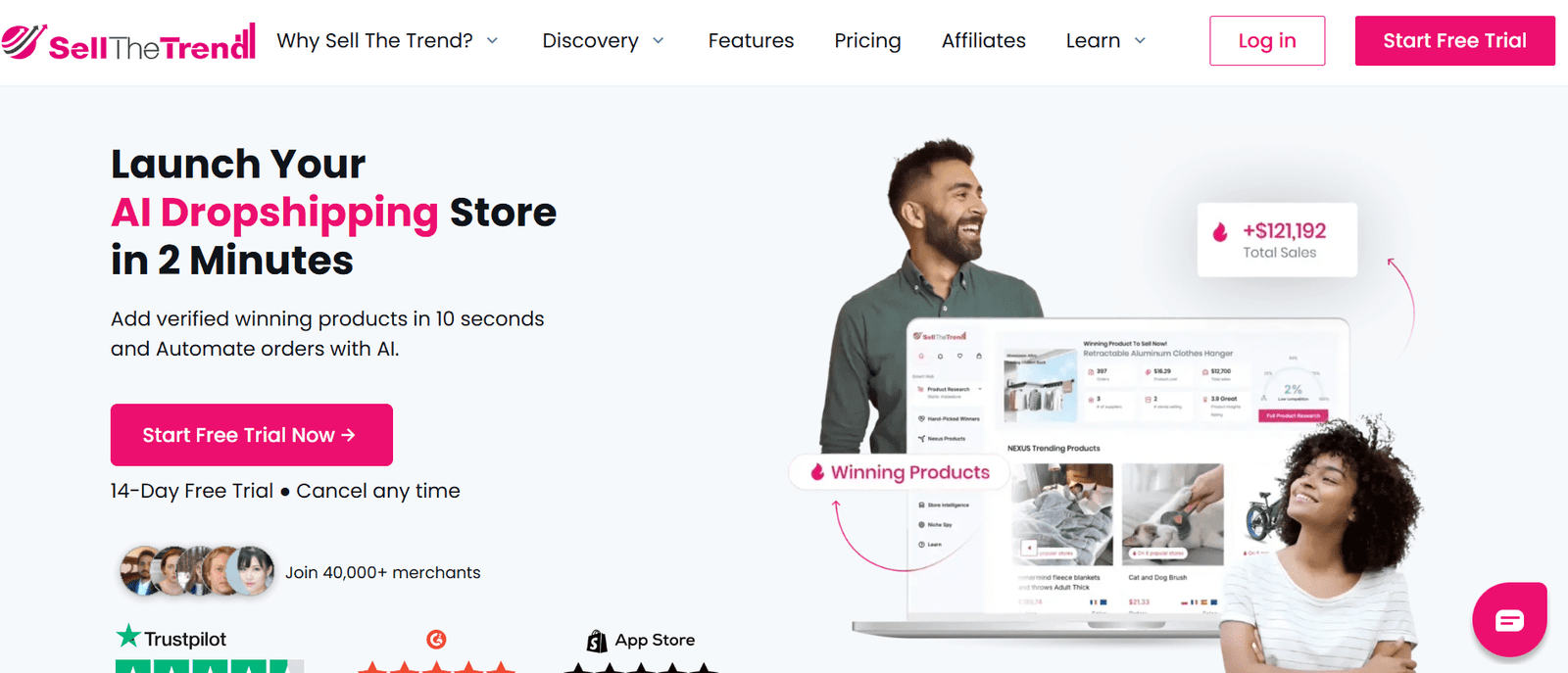
It makes dropshipping a low-risk business model for new entrepreneurs, since you’ll never have to carry inventory.
The good news is that Oberlo offers a free plan forever, which is ideal for first-time drop shippers.
It provides you with access to all its features and excellent customer service.
You’ll only pay for Sell The Trend once you go past the monthly 50 sales mark; up until then, you won’t pay a dime.
Please learn what you need to get your Dropshipping Startup Budget in order before you start your dropshipping business.
Domain Name
The domain name comes right on the heels of Sell The Trend, our third item, at a cost.
Trustworthy eCommerce businesses all have one thing in common: they have their own domain names.
You need to look the part; you must earn customers’ trust, because only then can you make sales.
Although Shopify offers a free myshopify domain name when launching, to strengthen your brand & legitimize your business in customers’ eyes, you should get your own domain name.
On Shopify, you can buy a custom domain for just $14 per year. Let’s add that to our budget. What do we have?
You can also connect an existing domain name to Shopify if you don’t want to incur the $14 fee on Shopify.
You can use cheaper domain name providers, such as Namecheap, which charges $9- $10 per year.
Thanks to Shopify, we’ve got an online store up and running. Sell The Trend makes it easy to find and sell products, and now we also have a professional domain name, so our budget is about $ 50, not bad for a slick store.
So, what do we spend our money on?
Successful 7-figure dropshippers assert that it’s unnecessary to spend your money on custom photos, logos, and website design. And that assertion is correct.
It’s pointless to spend money on custom photos, logos, and website design when Shopify can handle all of that. With Burst, you can find and use high-quality stock photos for free.
Whereas Hatchful allows you to create a custom logo in minutes, you can check out both Burst and Hatchful.
Still reading Dropshipping Startup Budget? Well, let’s debunk it further.
Sample products
Once you’ve secured a domain name, the cost of sample products is the next expense. In your budget, this item’s price is exceptionally high.
Dropshipping is phenomenal because you don’t have to carry any inventory of the merchandise.
You don’t control the quality of the items you sell, nor the packaging, nor the shipment times.
You must order sample products for two reasons: one, you’ll experience the customer journey first-hand; and two, you get to inspect suppliers.
If you can derive satisfaction from the packaging, shipping times, and product quality, your customers will experience the same.
If not, you can leverage Oberlo to contact the supplier to address your concerns. Better still, identify additional products or suppliers to sell.
The cost of your products will determine how much you allocate to order sample products.
Suppose each of your products costs about $20, and you order samples for five products; the total comes to $100.
At this juncture, let’s get back to our tally to set up a dropshipping business that now looks like this:
- Shopify online store is $29.99 a month,
- Oberlo forever free plan,
- A premium domain name is $14 a year, and sample products are $100, and you’ve got a cumulative total of $143.99.
Our startup bill is shy of $150.
What would you expect drop shippers to prioritize next?
The next point will answer this question.
Shopify Apps
The following cost item on our budget is apps. Think of apps as bells, whistles, and turbo boosters for your store.
The apps can help you run your store more efficiently and drive sales.
The good news is that the Shopify app store has many apps, and installing any of them is a single click.
With some apps offering free access and others charging a monthly fee, we’ve outlined the most popular apps for dropshippers below.
The apps are as follows:
- Cross-selling and Upselling: we’d recommend:
Cross-sell ($19.99/month)
Cart convert ($19/month)
Boost Sales ($30/month).
Bulk pricing: consider installing
Bulk Discounts & Sales Scheduled ($18.95/month),
Quantity Breaks ($16.99/month)
Discount Pricing ($19.99-$89.99/month).
Exit Intent: for Exit Intent apps, we’d recommend that you consider installing:
Exit Intent & Messenger Popups $29/month,
Spin-a-Sale ($9.99/month)
Wheelio ($14.92/month).
While neither of these apps is a must-have, they’re worth having.
The amount you spend on apps compared to sample product expenditure depends on your store and objectives.
But for the sake of our budget here, let’s set aside $19 to spend on various apps. Now our budget looks like:
- Shopify online store is $29.99 a month,
- Oberlo forever free plan, domain name 14 bucks a year,
- sample products 100 dollars and apps $19, and you’ve got a cumulative total of $162.99.
Read Also:
- What Is The Best 3PL For Dropship Fulfillment
- Why Paying For Dropshipping Courses Isn’t Worth It
- Is Dropshipping Legal For Under 18? Paying Taxes And Legalities
- Won’t People Find My Dropshipping Products Cheaper on Amazon?
- How To Dropship With AliExpress Using Shopify
Marketing
Marketing is a big priority, as it accounts for the bulk of our budget; here, you’ll make a substantial investment in your dropshipping business.
And Matisse, founder of artsy wall marketing, echoes the same.
And so Matisse holds that you ought to commit the lion’s share of your startup budget into marketing.
While there isn’t a specific price tag for marketing, we’ll need to estimate to get a clearer picture of how much you’ll need to spend on eCommerce.
We’ll use an average global conversion rate of 2%-4%; let’s use 2%.
This conversion rate means that, for instance, if you drive 400 people to your store, you can expect 8 of them to make purchases (400* 2% = 8).
But how do you draw 400 people to your store? Marketing.
Facebook makes for one of the most compelling marketing channels for dropshippers. That said, it’s worth assessing the cost of driving 400 visitors to your store from Facebook.
On average, Facebook ads have a click-through rate of 0.9 percent.
For our math calculation, let’s round that to 1% (1%). In other words, to drive 400 people to your store, you’ll need your ad to reach 40,000 eyeballs.
AdStage, a marketing software provider, reports the average cost per thousand impressions at 12.45 percent (12.45%). Again, to make the math easier, let’s round it off to 12.50 percent (12.50%).
With this equation, we can work to reach 40,000 people on Facebook in the US, alongside the price.
The equation involves first dividing the total impressions we target, 40,000 eyeballs, by 1000 (40000/1000), since the cost per thousand impressions is the industry norm.
Therefore, that leaves us with 40.
We then multiply the average cost per impression (12.50%) by 40, yielding a total price of $500 for Facebook advertising.
(40 x 12.50%)= $500 Ad Spend = 8 Sales.
A recap: to make 8 sales, we’ll need to reach 40,000 people and drive 400 to our store.
Now, let’s add this figure to our working tally:
- Shopify online store is $29.99 a month,
- Oberlo forever free plan,
- A premium domain name is 14 bucks a year,
- Sample products 100 bucks and apps $19,
- Marketing: $500; cumulative startup total cost for a dropshipping business: $662.99.
And you’ll be right to ask why incur $500 to make eight sales?
You can’t break even this way.
However, most six-figure dropshippers do not expect to make eight sales on the first marketing investment.
Instead, they look to study their customers’ interests, analyze the data, and determine which products to market, which audiences to target, and which ads to employ.
These types of statistics provide insights that help reduce marketing costs while increasing conversions over time.
To start dropshipping, you must become a lifelong learner. You must also ask yourself whether you are ready, able & willing to invest these startup costs.
Also, are you interested in investing time to learn the basics of dropshipping?
If so, the mega opportunity that comes with dropshipping can virtually change your life’s fortunes.
We have introduced lots of figures in this article, but we’re glad we can put them in context and perspective.
Dropshipping Startup Budget Summary
- Shopify Online store: $22.99/month
- Sell The Trend free plan: $0
- Domain name: $14/year
- Sample products: $100
- Apps: $19
- Marketing: $500
Total $662.99
Please share your thoughts in the comments on this Dropshipping Startup Budget. Is it realistic?
Too expensive? Or too low? Feel free to share your startup budget with us as well.
We’ll get back to you. Just before you leave, we have a small request: if you find the article valuable, please like it and share it. From here until next time, learn often, market better, and sell more.
Start Shopify For Only
Try Shopify free for 3 days, no credit card is required. By entering your email, you agree to receive marketing emails from Shopify.
Related Posts

Comments (0)